
Joyful Work
On working, striving, adapting, and a paradigm shift towards greater joy

I Wanna Go On
Time has a way of forming circles. On June 12, my own timeline formed a satisfying loop, as I stood in a dark room filled with beloved souls telling stories about a journey and lessons learned.
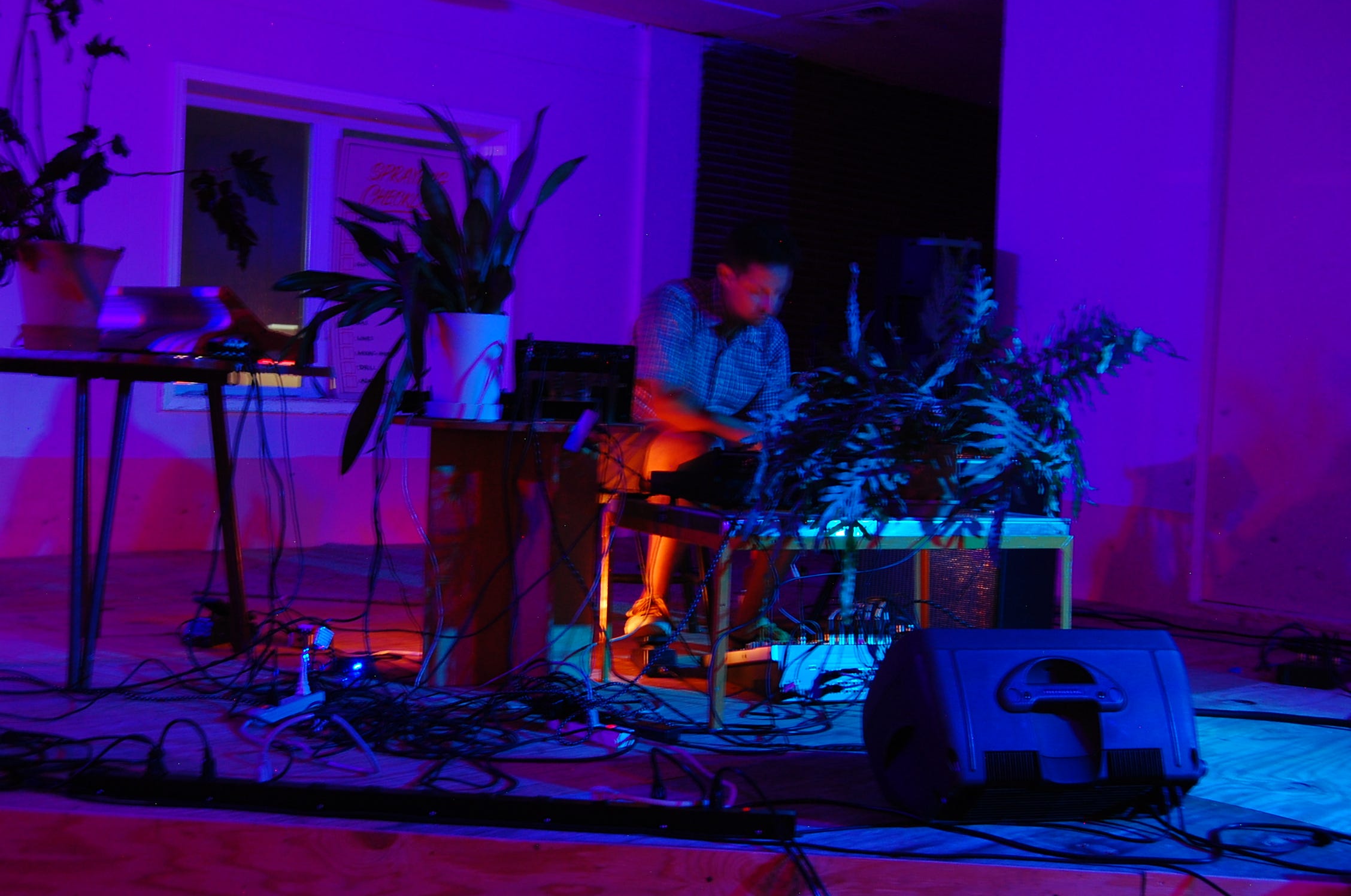
This scene unfolded in a bright pink room with projected images of bees, beekeepers, and American landscapes. The first “Bee Show”, was a culmination of two months on the road, and hundreds of hours shaping sounds, photographs, stories, and characters to share.
The basic elements were not dissimilar to a scene that unfolded one year earlier on my final day working at the organization I helped to conceive, form, and build—Impact Hub Baltimore. Both event dates were selected through guidance from the bees. Both gatherings culminated with me reading remarks. Both speeches ended with me imploring people to dream up more beautiful futures, and fight like hell to protect spaces and pathways for joyful work.


These sentiments represent a distillation of what I believe in. The form has shifted. My scope, tools, and muse have changed. My days revolve around my interests, obsessions, and philosophies rooted in honeybee wisdom. I’ve given up the status of a title and stability of a paycheck in exchange for the freedom to explore.
I loved organizing alongside social entrepreneurs and small business owners until it wore me out. The thrill of building up a collective movement of purpose-driven doers and dreamers faded under the demands of keeping an organization alive. It’s a wild thing to take on responsibility for making payroll and rent, while struggling against the calcified and uncaring economic systems we’ve inherited from our industrial forefathers. It might just break your heart to see how many hoops you must jump through to satisfy the demands of people who give money away and on whom you rely to subsidize the good hard work of making social change.
I learned in public health school that a system is perfectly designed to produce the results it achieves. I learned in community organizing that systems fight back to protect themselves. I learned in beekeeping that our systems have fallen out of balance, and we must adapt to survive.
After spending a couple decades dedicating long days and sleepless nights to toiling away in massive systems to entice them to shift, I opted out. I pulled my training and tools, frameworks, networks, and motivations away from the beasts who kept growling at me from their protective caves, and loosened up my struggling grip. I wrestled my ego away from its daily diet of attention and influence, and admitted that I needed space to breathe and learn and try on new modalities and muses. The honeybees became my newly appointed guides and agreed to help me navigate this space.
After exactly twelve months of exploration, I dimmed the lights, flicked on the projector, cued the playlist, and re-introduced myself as a newly minted, self-appointed bee journalist, artist, and organizer—equipped with the sights and sounds of other horizons, and ready to share my threads of insight with the world.
Stripped of All My Cares
I’m not the only one who has left some safe-ish, charted territory for new paths, less travelled. All around me, friends and colleagues devoted to meaningful work have found themselves at a crossroads, by choice or by force. Entire fields have been disrupted by self-interested power players. The death march of market growth keeps ratcheting up the degree of difficulty people experience in attempting to keep up and survive. Disorientation has become a certain kind of untenable norm. Those of us who dedicate our lives to striving around solutions have faced unprecedented headwinds and cracks in the system that you no longer have to squint to see. We live in a state of rupture. We were raised to put in years of hard work towards education and outcomes. Vestiges of loyalty to that status quo have begun to wane. Too many clauses in the social contract have been broken. Some folks refuse to sign back on.
Headlines reported on thousands of federal workers whose jobs were obliterated by unhinged maniacs who seem to hate the government, except when they become trillionaires off our tax dollars. The global health workers, FEMA staffers, and ecological research experts I know have faced identity ruptures and hard choices. Some have bitten the bullet and accepted private sector jobs. Higher paychecks ease the pain of loan forgiveness plans derailed by a forced departure from public service. For months, people cycled through stages of grief. By now, they may have accepted certain upsides of toiling on behalf of a bottom line.
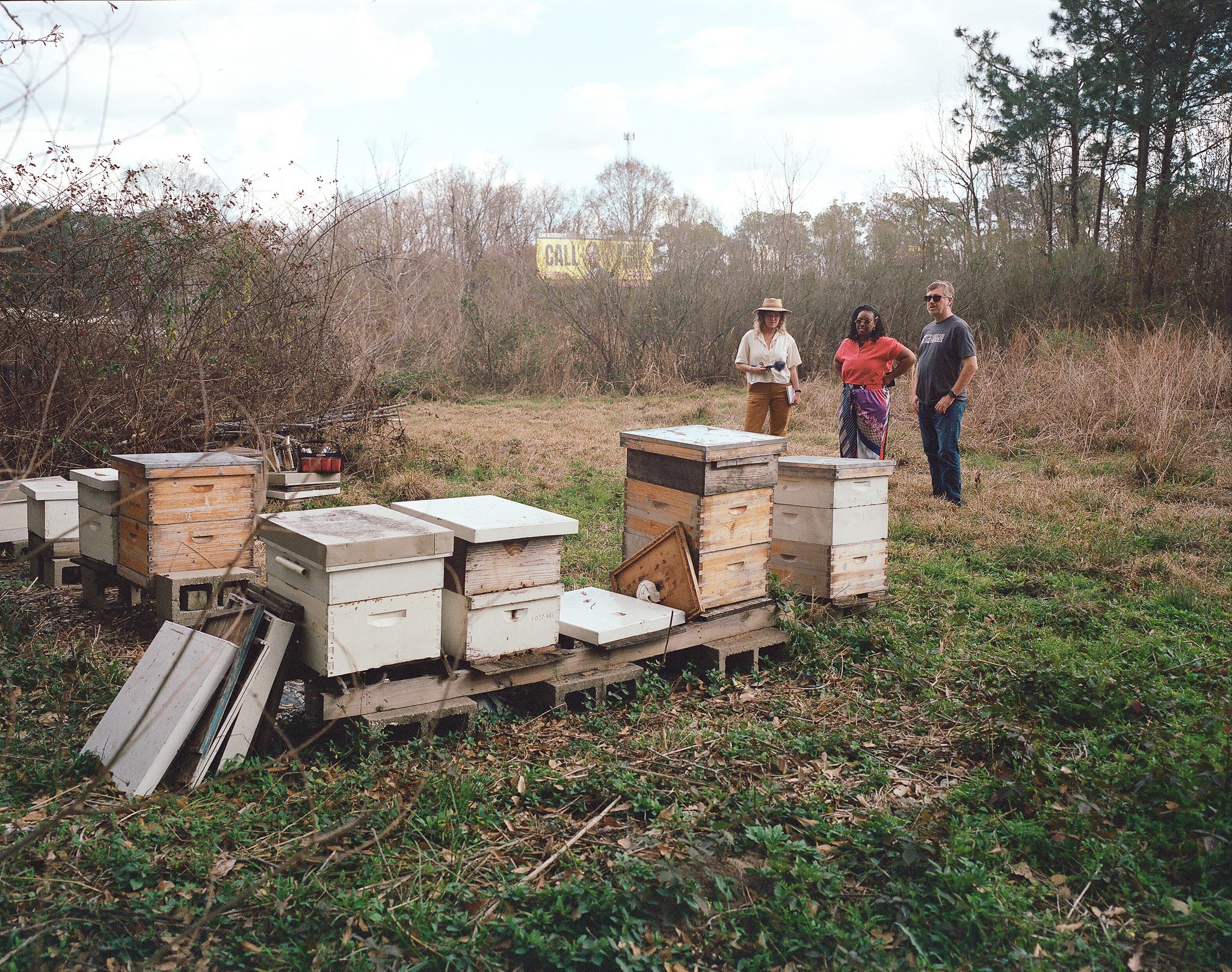
Some federal workers have pulled away from big systems entirely. They have become innkeepers in Illinois, full-time caregivers for young or aging family members, or beekeepers selling honey and restoring ecosystems at the edges of a community garden. They’ve stored up enough per diem and retirement benefits to attempt to build a brand new life that is hand-to-hand, day-to-day, and small in scale, perhaps with new types of satisfaction.
Journalists reporting on job sector disruptions early last year have experienced the ground falling out from below their feet too. Steady jobs at big publications got cancelled by the hundreds—a new wave in a sector tsunami that has been in progress for years. Seasoned mid-career millennials found themselves visiting old friends and aging parents more frequently while surviving on unemployment checks. They have launched Substack newsletters and hit new zines. They've faced tough choices between working for the hard-boiled capitalists alongside countless “market guys” or steering chronically under-funded non-profit news outlets.
Artists, organizers, and small business owners who have always been required to stay nimble face new struggles and adaptations. Legacy businesses have taken on loans and commercial real estate to create jobs and value for local communities. They manage to keep new contracts coming in and put new products on the market, while treading water to manage compounding debt and rising rents with limited options to build up breathing room. They wage partnerships, seek subsidy, and talk to bankruptcy lawyers just to keep all their options open. Meanwhile, properties on Main Streets sit vacant, while landlords get tax breaks on “capital losses”.
Gallerists have transformed into organizers, while organizers become gallerists. Artists, designers, and writers reboot their careers to pursue social work degrees. Last season’s doers recover from burn-out by becoming this season’s artists. Last season’s artists gather up new tools and skills. Those instincts for renewal have birthed underground music clubs; DIY venues; spaces for creative exchange; collectives; and exhibits exploring the edges of human experience. People have become new therapists, storytellers, teachers, and lobbyists, equipped with real life experience that gives their practices a rich hue.
All of this churn produces possibility and uncertainty. The risks of collateral damage are real. At the same time, the places where people choose to apply their skills and talents have been fascinating and instructive. I take comfort in knowing I’m not the only one stepping into the unknown. There’s great company out here in the ether. I also know I’m not alone in taking a deep look at the nature of work itself.
How Long Can This Go On?
During my first summer in the wild, I scanned the world for new inspiration, and came across the iconic book by Studs Terkel on work, titled “Working”. The subtitle “People Talk About What They Do All Day and How They Feel About What They Do” gives you a solid gist of these oral histories, published in 1974 and gathered across America over the course of three years. Terkel published this body of work about work during a time when work stared down dramatic shifts that people could feel coming. Not unlike today.
“As the automated pace of our daily jobs wipes out name and face—and in many instances, feeling—there is a sacrilegious question being asked these days. To earn one’s bread by the sweat of one’s brow has always been the lot of mankind. No matter how demeaning the task, no matter how it dulls the senses and breaks the spirit, one must work. Or else.
Lately there has been a questioning of this “work ethic,” especially by the young.” - Studs Terkel (1974)
Studs Terkel made his name in Chicago radio, and was well-versed in issues of industry, class, ownership, community, and culture. For a decade of his childhood, his parents ran a rooming house that brought him into contact with wide-ranging swaths of humanity. During his 45 years of producing a weekly radio show, he documented massive transformations taking place in America from 1952 and 1997 through interviews with Martin Luther King, Bob Dylan, Dorothy Parker, and other esteemed guests.
His book “Working” featured zero famous names. He felt strongly that everyone had the right to be heard and something important to say. And set about interviewing farm hands, sex workers, switchboard operators, ad men, stone masons, bookbinders, firemen, steelworkers, gravediggers, models, and nuns. The result is 589 pages of people’s own voices reflecting on their daily realities.
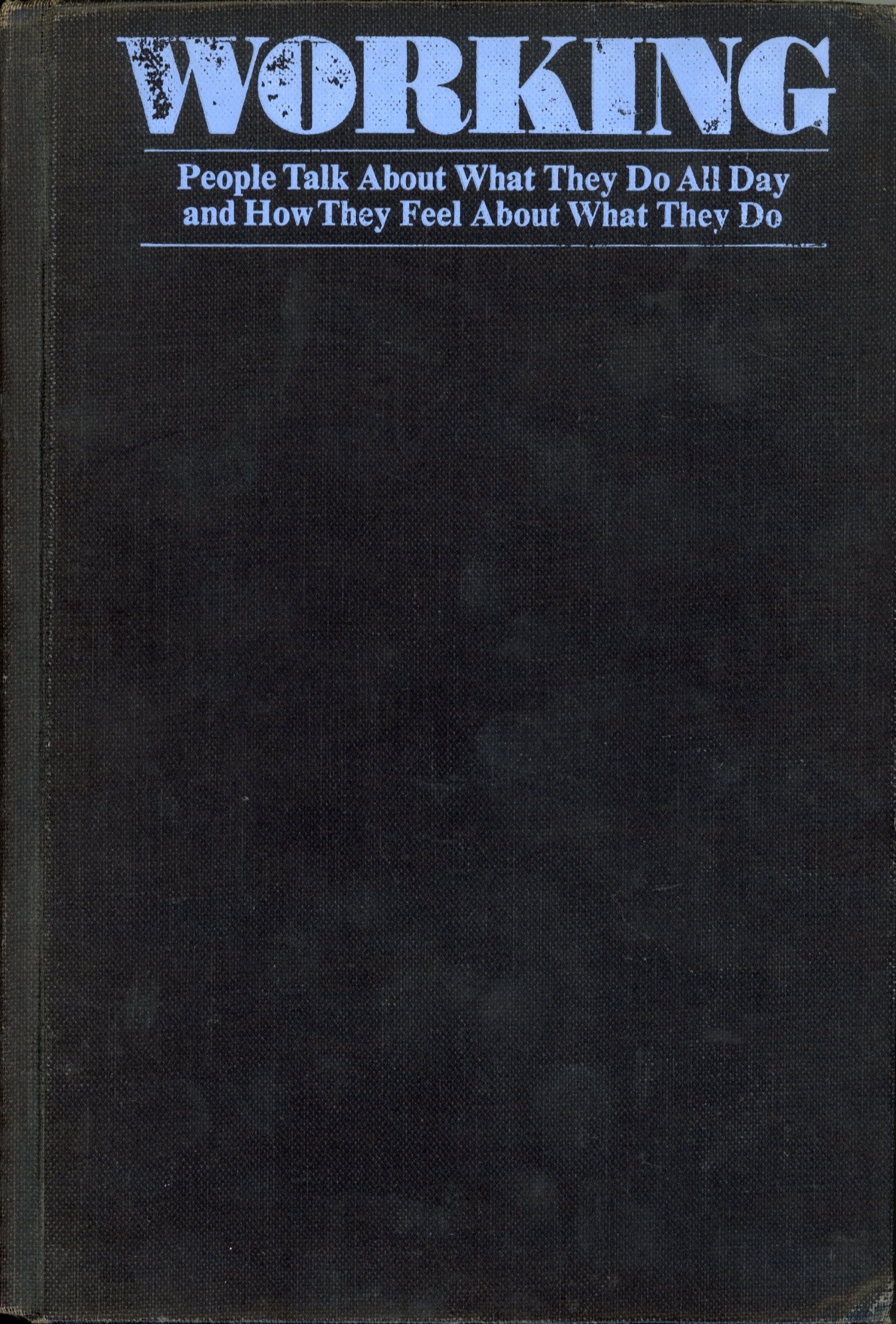
Working’s introduction bares the humanist stance of its writer:
“This book, being about work, is, by its very nature, about violence—to the spirit as well as to the body. It is about ulcers as well as accidents, about shouting matches as well as fistfights, about nervous breakdowns as well as kicking the dog around. It is, above all (or beneath all), about daily humiliations. To survive the day is triumph enough for the walking wounded among the great many of us.
It is about a search too, for daily meaning as well as daily bread, for recognition as well as cash, for astonishment rather than torpor; in short, for a sort of life rather than a Monday through Friday sort of dying.” - Studs Terkel, “Working” (1974)
Terkel left the comforts of home to listen to the dreams and discomforts of his fellow Americans and seek some shared truth. The work lacks the cloying patriotism or cookie cutter politics you might find by someone encamped solidly in the right or left. Instead, it allows people to speak for themselves in their own voice—rich with complexity and no specific agenda. People speak of pride and a sense of purpose. They speak of feeling demeaned and surveilled and micromanaged. Some yearn for technology to come for their jobs. Some fear that progress will obliterate their identity.
Studs’ book became a runaway best-seller, perhaps unexpectedly. Readers felt seen and understood in ways that may not have been reflected in the political and economic rhetoric of the time. My own copy inspired read-alouds and conversations—remarking on people’s honesty about the games and schemes of work. The ad man spoke of boosting his salary and reputation with arbitrary decisions made to seem important to clients. The sex worker admitted how many famous and respectable men relied on her services. The telephone operator described the joy and power derived from listening in on conversations. A steel worker wished that skyscrapers were adorned with the names of men who built them.
Certain common threads highlighted for me the sense of purpose and pride felt by workers with different backgrounds and roles. They endured daily hardships and humiliations to access a sense of satisfaction. Beyond putting food on the table and keeping the lights on, people found glimmers of joy in their work.
Studs Terkel called attention to how work makes us feel. By examining how work simultaneously kills us and motivates us, he tapped into a dimension of work that rarely gets enough lip service when we leave all the talking to experts and industry leaders. The feelings around work do matter—both in terms of personal experience, and assuming a role in a family or community.
As we stare down new paradigm shifts today, it may be time to center conversations on how we want to feel. In the midst of this shift, we must protect pathways to joyful, meaningful work.
Never Minded Working Hard
I once heard a helpful distinction between the concepts of happiness, pleasure, and joy. The source has left my memory, but the essence is that happiness and pleasure arise from external sources, often fleeting and reliant on consumption or release. Joy, on the other hand, bubbles up from some internal place, more grounded and enduring. Joy stems from a steady sense of meaning, connection, or purpose.
Joy being a personal experience, it must vary considerably from one person to the next. For me, it’s wrapped up in a sense of freedom, flexibility, creativity, and beauty. I derive joy from having a sense of purpose, making progress, and producing a tangible result. I feel joy in a sense of belonging, and in having space to enjoy people or places I have grown to love.
There have been times in my life when work made me happy or produced moments of pleasure. It also generated pressure and stress to adhere to standards and goals set by other people. My career and skillset was forged by tackling hard problems in hard places with serious people. I found joy in the relationships formed, victories won, and progress attained. At the same time, much of the joy in my life came from my identity outside of work.
I’ve had the good fortune of opportunities that allowed me to get tangled up in work without major hardship or injury or sacrifice. For folks interviewed in “Working”, the joy they found in demanding jobs often came from pride in their accomplishments, as well as down time, banter, and goofing off in between productive periods. In the 1970s, workplace camaraderie was starting to be compressed and eliminated by technology that prioritized efficiency over all things, and allowed owners and bosses to monitor employee labor minute by minute. The feelings of joy and freedom were getting squeezed out. They felt dismayed to be treated as dispensable cogs in a big machine. Today, most people of working age came up in that reality. We’ve not known a time when efficiency did not lord over a day’s work.
We have also not known a time when GDP and job growth did not define the national conversation on work. “Jobs” and “work” as concepts have been used interchangeably. If you clock in to a place of employment, you count towards the country’s bottom line. If you do not fill in a timesheet, people say you “do not work”.
Mothers, artists, craftspeople, caregivers, healers, organizers, activists, spiritual leaders, land stewards, and poets have spent centuries producing indispensable value for society, as well as meaning for themselves, their families, and their communities for little to no pay, while relying on other means to survive. Most derive tremendous joy from these roles. They apply time, skill, talent, and devotion to a body of work that so often gets taken for granted because it transpires outside the market.
Beekeepers find themselves among the ranks of joyful people who labor for the love of the work. Most do it for the love of bees. They are fascinated, curious, and see the value bees generate. They engage in exchanges that have forever been difficult to price or quantify in economic terms. Should honey be expensive or free? Should farmers pay for pollination or should beekeepers pay for land? None of these economic puzzles deter beekeepers from the work. Their big picture mindset may stem from working alongside a superorganism perfectly evolved for collective wellbeing.
If you watch honeybees long enough, you’ll see they model joyful work in every waking minute. No hierarchies demand productivity. Life cycles and weather define specific roles. Bees labor all day for the sake of themselves and the collective. They operate in seasonal rhythms of co-creation with flowers and trees and land.
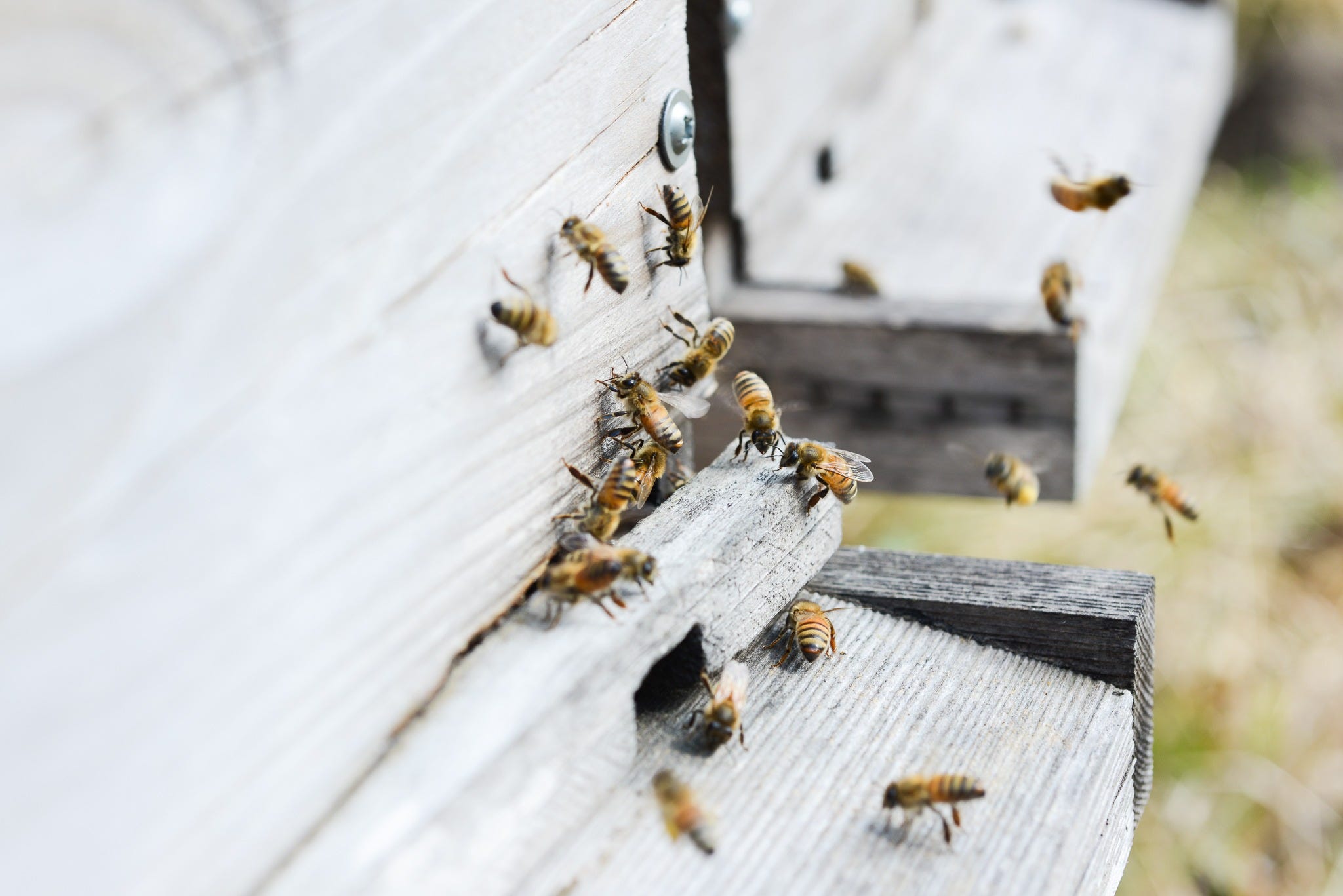
During my first summer of freedom, a newly spacious calendar allowed me to operate more similarly to the bees. I adjusted with the weather and changed focus from day to day. I gathered up new skills that could be useful to me and my larger community. I worked with my hands, learning to print, type, weave, dye, write, and keep bees. I spent time in tool libraries, art galleries, film festivals, bee yards, land collectives, and print shops. All of these vantage points got me thinking about “joyful work”.
When I travelled to Amish country to buy perennials and beekeeping equipment, I marveled for the first time that NONE of the Amish community fills out a timesheet at a corporate job. Nearly half a million people. Operating on principles of self-reliance and hard work. Running successful farms and businesses all day. No one aiming to get famous, rich, or powerful. Very much the opposite1.
In recent weeks, I’ve heard writers, open source coders, and business owners fantasize about becoming “neo-Amish”. They admire their work ethic. They admire their stance on technology and community. Horses and buggies are starting to look futuristic.
Sara Horowitz who leads the Mutualist Society came to speak with grassroots leaders in Baltimore and nudged us to consider technology through an Amish lens by asking, “Is this beneficial to me and my community?”. If not, it may be time to opt out.
The Bee Show
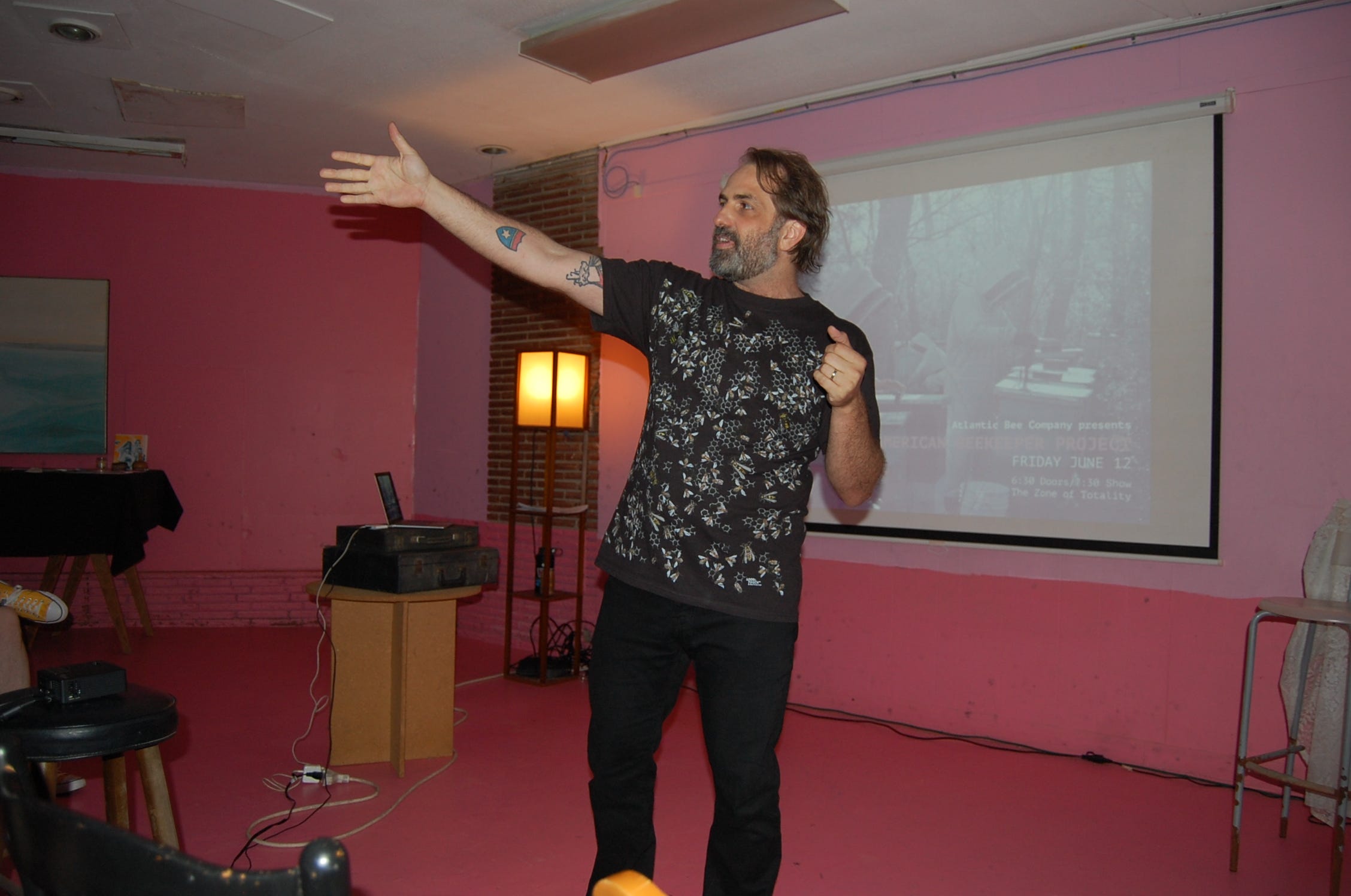
As the light faded on June 12, fifty bodies gathered in a bright pink room to gaze at a white screen filled with projected images. I worked 12-hour days for three weeks for the Bee Show to take shape and allow us to share stories from our AMERICAN BEEKEEPER project and the road trip that kicked it off at the start of 2026. We stood in front of an audience of colleagues, friends, and neighbors at the Zone of Totality2, and told stories of eclipses, dreams, forgotten places, crumbling systems, and healing land. Dozens of people listened for nearly two hours, laughed at our jokes, gazed at photos, cheered for our charismatic puppy montage, and leaned in to catch the lessons we gathered from land and bees and beekeepers who opened up their lives3. It was magic.
I closed the night with a typed essay born from the stories we heard on the road—woven together as a sort of manifesto and read to the epic closing track “Manifest” from Dan Deacon’s America4.


People clapped! Attendees expressed an interest in learning from bees, and a hunch that it’s important. Indeed I think it is.
Bees give us a model to hold up and compare to what humanity presents as good or inevitable or normal. They allow us to do a gut check about whether the stories we’re telling about ourselves and our futures will actually lead to better states of affairs.
To find our way out of this country’s chronic despair, unrest, division, neglect, and abuse, it’s time to ask new questions. It’s worthwhile to pay attention to how we want to feel, how we cultivate meaningful lives, and how we tend to the living beings and land that always sustain us. It’s time to question how much greed, fame, and politics shape our dreams and realities.
We may be best off steering this next paradigm shift from the ground up. Before we look to the the public or private sector for solutions, we can look to ourselves and our communities. We can respond to immediate needs and build small, meaningful contributions right where we are. We can create new models of care and survival by aggregating our resources to protect what we need. Honeybees, Amish communities, and mutualist organizations provide some sources of inspiration5.
There are humans who love the work they do. Communities and religions centered around the sacred nature of work. Indigenous lineages worldwide who raise children into roles that were created by their ancestors and refined over generations.
We do not have to settle for being consumers of a world that other people build. Our nature is to produce. It makes us feel good. We create assets and beauty, reasons for living, and quality of life. We are part of a larger human fabric and part of the natural world. We do not need to remain satisfied with anyone pushing their own agendas or painting bleak futures dominated by billionaires, dying land, and robots. The human imagination is infinite, and our capacity for joy is a compass.
People want to form families, make art, share meals, build homes, tend land, and come together around ritual, meaning, and rhythms of life. These are ancient truths, neglected in modern life.
Now is the time to find our way into joyful work. And to insist that any revolution in our economy and any use of our natural resources must be conducive to supporting vibrant, abundant human and non-human lives. With purpose. Using what we can do fully. Accepting our calling as stewards of the land and life on earth.
As I respond to this call, I am navigating the least financial stability I’ve had in my career. For now, I am living off my savings, Andy’s consulting gigs, small art grants, publication pitches, and a dozen paid subscribers here. (Thank you!)
I am experiencing tremendous creative freedom. I’m developing my voice and deeper purpose. And I’m building a muscle for joy.
To everyone who has shown up to applaud in the darkness, thank you. It means so much. I will come to your Bee Show next.
In the meantime, let’s dedicate ample time and attention to acts that make us feel alive. We know all too well the “Monday to Friday sort of dying” described by Studs and so many workers. We owe it to future generations to cultivate joyful living instead.
BONUS MATERIAL: Music lovers may enjoy guessing the songs that inspired section titles in this post. Listen via this playlist.
I would love to hear from folks on working, striving, adapting, and any seeds of joyful work you encounter in your lives. Leave a note!
On our last trip to Lancaster County, we picked up two books on the Amish that have been fascinating reads, and illuminating their beliefs on work, community, land, and faith. “The Riddle of Amish Culture” and “On the Backroad to Heaven” by Donald B. Kraybill. Would recommend!
The Zone of Totality refers to BOTH the band of shadow cast by a total solar eclipse where onlookers can experience the phenomenon of darkness during the daytime, AND to the DIY art space in Baltimore which bears this name. It’s one of those spaces where you know someone doing a thing or you get a flyer that says “ask a punk”.
Andy Cook photography can be found at his Substack, including these gorgeous nine photos selected from the Bee Show. Peruse here.
Let us pretend, for now, that the Bee Show was not unlike this long, yet mesmerizing and complex music video for the four-part USA I-IV composition by Dan Deacon, aired in 2013 on Adult Swim. Enjoy here.
The Mutualist Society led by Sara Horowitz will soon launch a Mutualist Press. Stay tuned for those conversations here.