
Honey Queens
Scenes from the American Beekeeping Federation conference

Honey Queens
The reign of an American Honey Queen lasts one year. When I met Cheyenne Bastian-Brown at the American Beekeeping Federation conference in Mobile, Alabama, several hours remained before she transferred her title, sash, and tiara to the next American Queen.
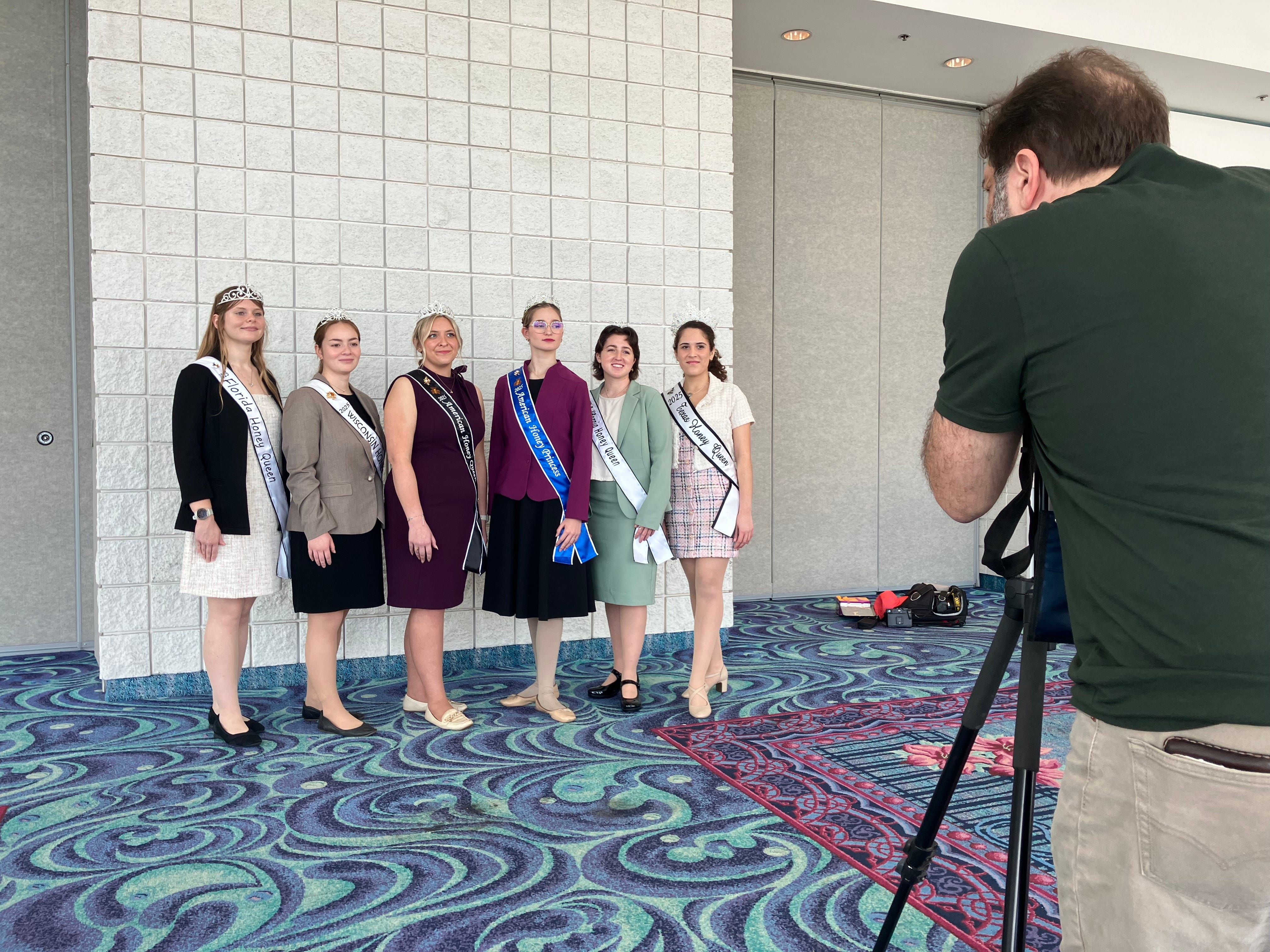
I first spotted the Honey Queens walking the trade show floor. Their tiaras and sashes make them stand out among a sea of beekeepers, researchers, and beekeeping equipment. They won my full attention and support when they took the stage to give their introductory remarks. The reigning American Honey Queen, Honey Princess, and State Honey Queens from California, Florida, Texas, and Wisconsin introduced themselves on the first day of the conference to share their impressive goals and backgrounds.
These women hold undergraduate and graduate degrees in entomology, veterinary medicine, animal biology, plant biology, sustainable botany, and forestry. They aspire to influence public policy and public opinion through public speaking and legislative advocacy. Several have been certified as Master Beekeepers in their state, and conducted research at university Bee Labs. One studied with Guyana beekeepers in the Peace Corps. One is allergic to bees.
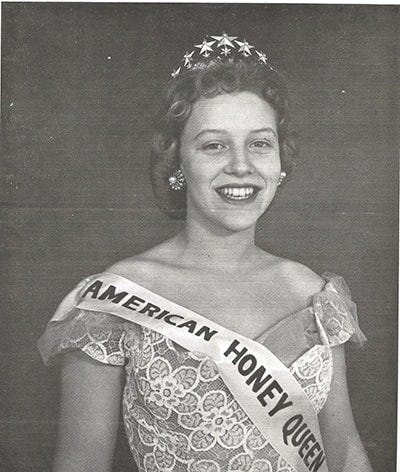
The American Honey Queen program started in 1959 with leadership by women beekeepers involved in the American Beekeeping Federation as a way to bring visibility to women in the field, and a means of bringing representation to the beekeeping industry and its interests. Wisconsin launched its State Honey Queen program in 1956 and inspired this concept to spread nationally.
A common talking point across the current Queens is that while people have gotten behind the movement to “Save the Bees”, Americans need to understand that it works the other way around. By pollinating one third of the food we eat, the bees sustain us. Facing tremendous pressures from varroa mites, pesticides, herbicides, and the loss of agricultural land, honeybees have been losing ground over the past several decades. These women acknowledge tensions between the interests of big agriculture and healthy honeybees, but feel the solution lies in communication and collaboration across the industry. Relative to chemical companies and other players in this field, the beekeeping lobby is extremely small. Beekeeping advocates cite two lobbyists dedicated to bees.
The American Honey Queen, Cheyenne Bastian-Brown of Ralston, PA spent 134 days on the road and travelled to 19 states during 2025. Her counterpart, the American Honey Princess, Emilia Burnham of Murrieta, CA dedicated 114 days to honeybees across 15 states. Each of them has studied a packet of reference materials three inches thick, undergone a week-long evaluation by industry leaders, and interviewed with the Honey Queen committee. The committee looks for women who demonstrate interest, personality, writing skills, public speaking skills, poise, and confidence. Once selected, they meet with local beekeepers, train with industrial beekeeping operations, and travel the country speaking with legislators, researchers, classrooms, festivals, and fairs.
Previous Honey Queens have gone on to become mentors and role models to women coming up in the program and industry. Anna Kettlewell served as the Wisconsin Honey Queen in 1998 and the American Honey Queen in 1999, and oversees the program today. Many of the Honey Queens cite her as a mentor and role model.
Virginia Webb served as the Tennessee Honey Queen in the 1960s and has gone on to become a tremendous leader in the industry. She is the only person in the US to hold three Master Beekeeper certifications. She has served in leadership positions with the Metro Atlanta Beekeepers Association, Georgia Beekeepers Association, American Beekeepers Federation (ABF), and Farm Bureau Honeybee Advisory Committee—often as the first or only woman in these roles. She has been named Beekeeper of the Year for Georgia, North Georgia Farm Woman of the Year, and her honey has been named as the Best Honey in the World four times over the past 25 years.
On the final night of the ABF conference, Virginia Webb won the vast majority of raffle prizes. So many that she passed on at least one of the prizes to let other participants win.
Shortly after, as the final act of the entire conference, a new American Honey Queen and Princess were named. These are the next women to watch, and deserve more coverage than I can manage here.
The incoming Honey Queen, Delanie Craighead of California studied animal biology and veterinary medical entomology at UC Davis. Her passion for beekeeping began with research at Davis’ Honeybee Lab. Her true passion lies in parasites. When asked if she would apply to be a Parasite Queen if there were such a role, she replies with an enthusiastic, “YES!”. This may prove to be an opportune time to have a parasite expert in this role, as American beekeepers work to prevent the arrival of the “tropy mite” to our shores. Delanie sees promise in gatherings like ABF where small and large scale beekeepers come together to spark creativity and progress.
Alongside her in 2026, Oceanna Escribano of San Antonio, Texas will serve as the American Honey Princess. She graduated from UTSA in May with a bachelors in plant biology and French, and hails from Puerto Rico where her grandparents kept bees for 50 years. During her studies, she researched the medicinal properties of honey and bee behavior during the 2023 and 2024 eclipses. The HONEY pathway research projects have begun to map the antimicrobial, antioxidant, and medical applications of honey. Oceanna shares a story of a sword fighter in Malaysia whose experimental honey treatment cured a major infection, saving his arm from amputation. Her research on bee behavior during the total eclipse in 2024 got a mention in the New York Times. To Oceanna, driving research that can revolutionize medical practices or spark popular interest matters far more than her own achievements. She says, “knowledge is for everyone” and draws inspiration from bees as a collective organism that works together.
The outgoing Honey Queen describes her past year as an “unforgettable” experience. Having met the incredible women stepping into these leadership positions in 2026, I have no doubt that they too will leave an indelible mark on everyone they meet.
American Beekeeping
The conference in Mobile marked my first year attending the American Beekeeping Federation conference and trade show. I learned about the meeting from the One Hive Foundation’s travel grants to attend a session by Dr. Judy Wu-Smart on policy and advocacy for honeybee health. She directs the University of Nebraska-Lincoln Bee Lab and has been battling the devastating impacts of stressors to bee health including neonicotinoids and other pesticides for many years. While plenty of beekeepers report colony losses due to varroa mites, agricultural chemicals have a major role to play in losses and can be harder to detect.
Research presentations serve as a defining feature of the ABF conference and motivate many beekeepers to participate. Last week, presentations focused on experiments in bee nutrition from healthy landscapes, citizen science to map pollen and nectar sources, and studies of environmental perturbations impacting the health of colonies, often attributed mistakenly to the health of a queen.


One session taught beekeepers to conduct sampling and microscopy to detect honeybee pests, including the tiny, deadly tropy mites.
Practical sessions taught advocacy skills, fundraising for community projects, and small business strategies to drive income from beekeeping without migrating bees.
Pollination contracts, especially for almond pollination drive large portions of income for industrial beekeepers. In these operations, honey generates far less income and will often be sold to consumers and other honey producers with a custom label denoting their brand. From the estimated 2.7 million honeybee colonies in the United States, two-thirds travel the country each year pollinating crops. The California almond industry alone, requires an estimated 1.8 million colonies of honeybees to adequately pollinate nearly one million acres of almond orchards1.
In addition to almonds, honeybees pollinate blueberries, cranberries, watermelon, pumpkins, squash, and apples, among other familiar crops. The FDA cites over 90 crops that rely on bee pollination—representing an estimated $15 billion in value to the agricultural industry of this country2. A collapse in bee populations could lead to mass starvation and a transformed diet for countless Americans. Solutions to this threat remain elusive and complex, as the pressures faced by bees are many and tied to industrial practices in agriculture that become more engrained with every chemical or engineered seed introduced. Mites and climate change merely up the ante on threats faced by bees.
Honeybees travel across the US by the millions. At the conference, I met Chris Hansen, a beekeeper based in northern Wisconsin who estimates that his small company transported 99 million bees across the country last year. He has two trucks driving package bees continuously over 100 days a year from California to Arkasas, Idaho, Colorado, Utah, Texas, Missouri, Kentucky, Minnesota, North and South Dakona, Wisconsin, Illinois, Ohio, Indiana, Michigan, New York, Pennsylvania, and Vermont. Each full truck carries about 2,500 packages of 22 million bees, representing $400-500,000 in paid merchandise per load. He takes ventilation seriously in the design of his trucks so bees do not suffocate during the trips. Hansen Honey logs 76,000 miles in 5 weeks just transporting bees from production facilities to customers around the country.
Chris also sells honey and beekeeping equipment. In years when his own honey production is light, he trades pollination beekeepers equipment for honey to satisfy demand. Last year, honey production was down to 4 pounds per hive, which is a significant drop from the 40 to 60 pounds generated on average per hive in Wisconsin. The season is short and weather can have a dramatic impact.
Over the course of the week, I met interesting, dedicated, warm people like Chris from across the United States. Many operate small family businesses and generate income from multiple sources. They manage community gardens and university apiaries in Alabama; colony removal services in Chicago; commercial kitchens in Detroit; cafes in Pittsburgh; educational initiatives in New Jersey and Puerto Rico; and a bee-tique in Ohio. Many sell honey at farmers markets and light up when they share their experience.
Over the coming months, I aim to visit as many of these fascinating people as possible and share their stories here.
Mechanics
At the start of any trip or project, there are plenty of logistics to work out. We are hauling five cameras, fifty rolls of film, one digital recorder, one electric typewriter, a dozen beeswax candles, and more notebooks and zines than I care to count.
On the first day, our heavily loaded 2011 Volvo wagon made the trek down to Washington Virginia to complete the first leg of travel and stay in a little mountain cabin next to the Appalachian Trial in the Shenandoah Mountains. We arrived around sunset, made our way up the steep and rutted driveway that is half a mile long, and discovered a huge oil stain at the top. I wished desperately for this fresh oil spill to have been left by the previous cabin dwellers, but knew in my gut that it came from us.
A pointed rock in a low rivulet halfway up the driveway had torn a hole in our oil pan. Leaving us at the top of a mountain on a Friday night with a dead car and no cell phone signal. I’ve never felt quite so vulnerable so quickly. Having either a car or a cell phone will get you out of most pickles. Taking both down at once makes requires a lot of patience and creative troubleshooting.
We walked down the mountain a mile and a half each day to get a cell signal, and eventually managed to get a tow. Our tow driver Brandon was brave and enthusiastic. He helped us to make a three point turn with no engine, up a hill, backward. And rolled the car down the mountain in neutral to meet his truck which could only make it so far up the drive. He also drove us to Charlottesville to the highway robbers at the Volvo dealership who have now fixed the car and await our return. For just a couple thousand dollars.
The bright side will no doubt make itself apparent eventually. For the time being, we’re still working through schedule adjustments and gradually working our way back north before heading south again. It’s a reminder that road trips serve up adventures you never expect and an invitation to relax and appreciate the ride.


We’re grateful to have good friends, lunch counters, and welcoming beekeepers along the route to make all the miles feel worth it.
Thanks to all of you who are following along as we go!
From the American Beekeeping Federation (ABF) website: https://abfnet.org/pollination-facts/
From the US Food & Agriculture Department (FDA) website:
https://www.fda.gov/animal-veterinary/animal-health-literacy/helping-agricultures-helpful-honey-bees#:~:text=It’s%20their%20work%20as%20crop,bills%20buzzing%20over%20U.S.%20crop