
Collective Transformation
Reflections on the rituals and transformations of Mardi Gras

Tuesday marked two weeks since Mardi Gras Day in New Orleans. We participated in dozens of beautiful and transformational experiences leading up to the culminating day. Beekeeper interviews and side trips got woven in. Cold days gave way to warmth and sunshine. I am still unpacking physically and spiritually from the trip, and sorting through how to share it.
This is the first in a series of essays about our time in New Orleans and Lafayette, Louisiana. Lessons from the humans, bees, cultures, land, and waterways of southern Louisiana intersect and intertwine. It feels fitting to start with celebrations.
Mardi Gras Season
It’s hard to describe the season of Mardi Gras in New Orleans to anyone who’s never been. There is no one singular experience that defines it. Over three weeks, Carnival season charges the city and generates a magnetic force that pulls people from their houses into the streets to march, costume, revel, and celebrate.
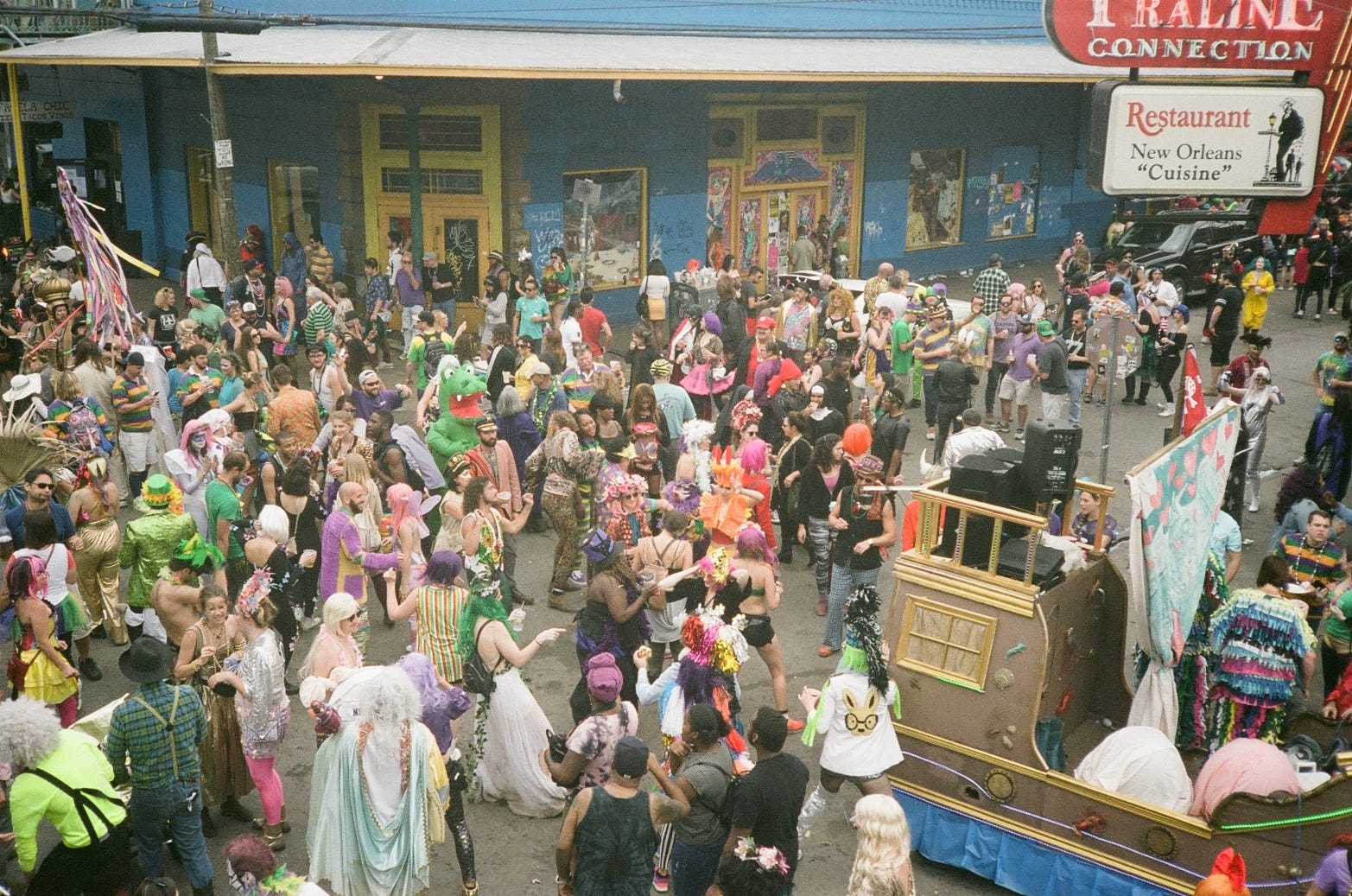
Mardi Gras spreads everywhere and serves everyone. It has no centralized organizing body. There are no tickets to get in1. Though it helps to know someone who lives in New Orleans that can keep you informed, show you the ropes, and help you get around2.
There are so many possible Mardi Gras experiences that it is impossible to do it all or see it all. Your best bet is to find your people, dress accordingly, and follow the crowd. There is no right approach, right place, right parade, right costume. The objective is to get oriented, get loose, and go with the flow.
Our trip to the Gulf Coast region was built between two bookend events—the American Beekeeping Federation conference in Mobile, Alabama and Mardi Gras in New Orleans. The start and end to these events spanned seven weeks, which teetered on the edge between a reasonable and unreasonable amount of time to be on the road. Ultimately, we deemed it reasonable, notified our friends in New Orleans, secured a place to stay, and headed south.
What’s Carnival For
My husband, Andy lived in New Orleans in his twenties and guided me into my first full Mardi Gras season in 2018 with big help from old friends—lifelong and longtime residents who stay tapped in. They lent us a spare bedroom, opened their costume closets, and shared local knowledge of what to do and where to go.
Initially, I needed to be convinced to go. I asked Andy to get me over the perception that many folks who live outside of New Orleans may hold. In short, that Mardi Gras is all floats, drinks, boobs, and beads. As if Bourbon Street culture has metastasized, spread to every neighborhood, and built itself Disneyfied floats. This version of Mardi Gras may exist on the surface level of big, permitted parades and in certain locales.
Visitors and residents who love a big street party can stand in huge crowds reaching their arms longingly towards bright floats pulled by tractors to get plastic beads. They will get beads by the handful of all sizes and shapes. They will also hear some of the city’s best brass bands; marvel at committed residents who have camped out in prime locations overnight; and wonder how some members of the crowd seem to so casually secure glittering Muses shoes, Zulu coconuts, and other prized parade throws3.
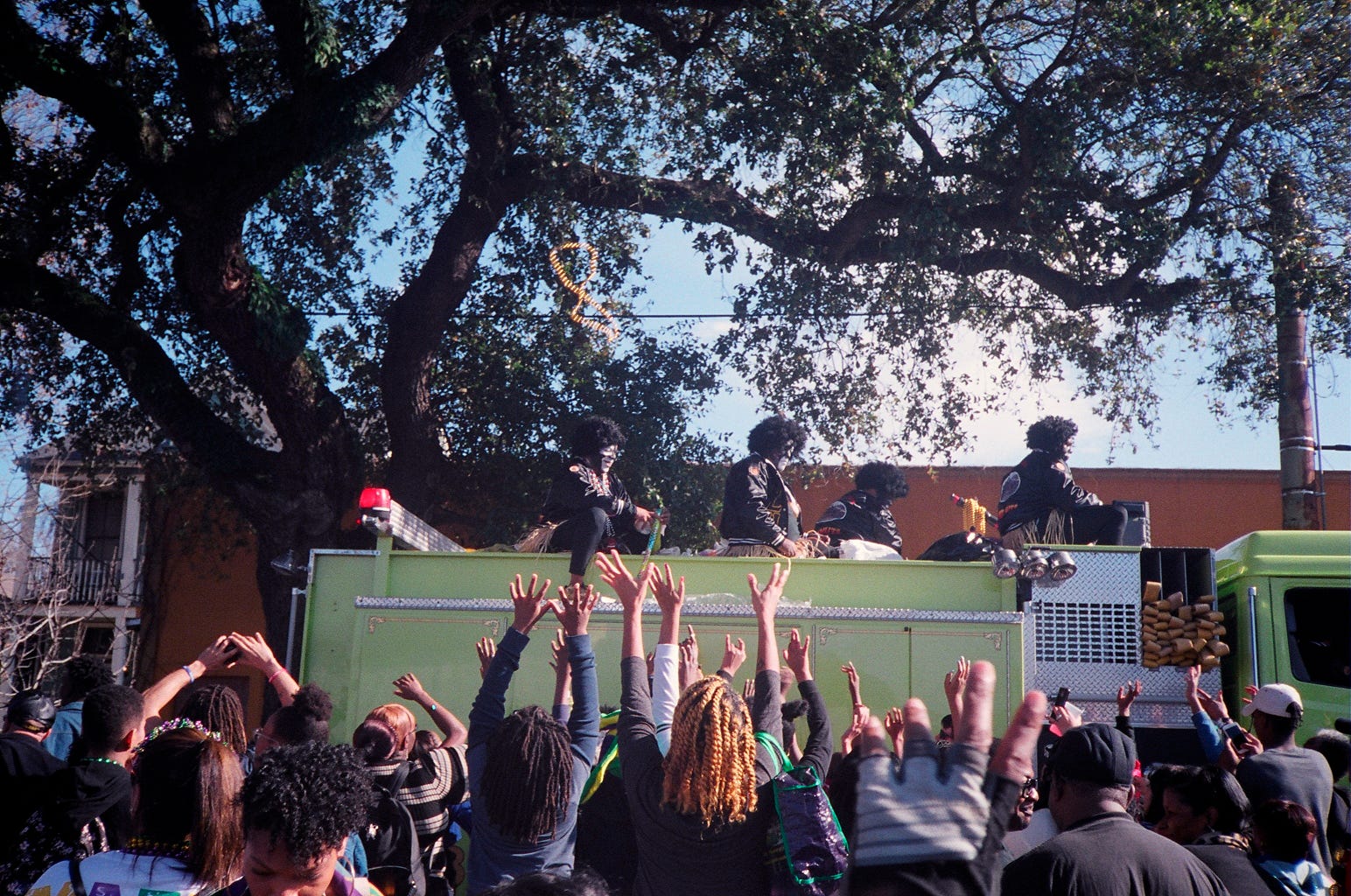
Newcomers will gradually see that Mardi Gras involves a whole lot of skill, preparation, local knowledge, and magic. No spectators. No rules. Participation and creativity beget rewards. Mardi Gras has been built by many hands over many months in many corners of the city. And if you truly give it its due, over centuries.
On Mardi Gras morning in 2018 and again in 2026, we began the day with the Skull and Bones Gang, which originates in 1819 with roots in Haitian and West African spiritual traditions. Radio broadcasters at WWOZ name this as the oldest Carnival tradition in New Orleans. Skull and Bones represents the shedding of the flesh. Skeletons with paper mâché masks process through the streets before dawn—drumming, announcing the day, invoking the ancestors, and reminding crowds that our time in this mortal body is finite.
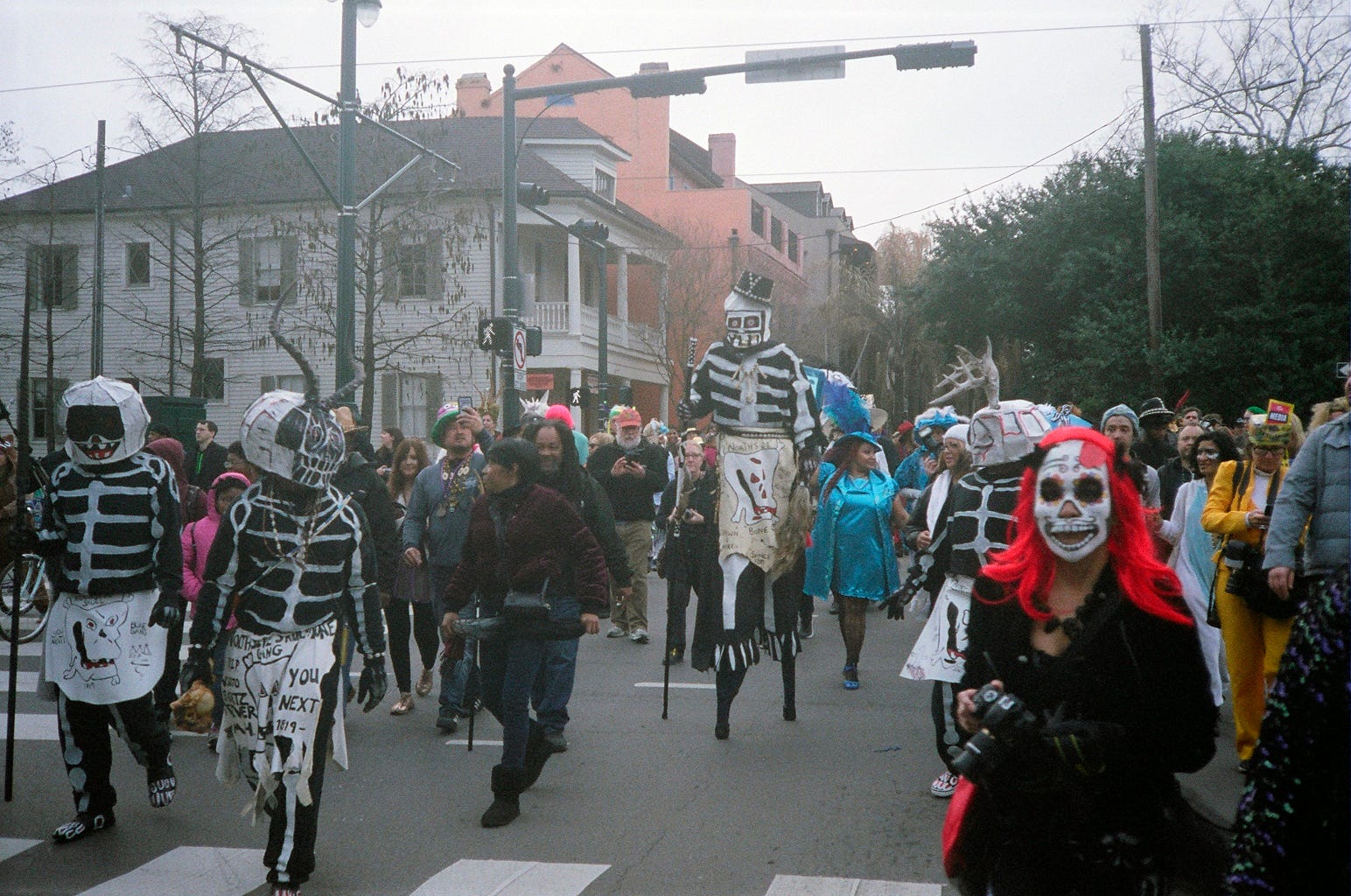
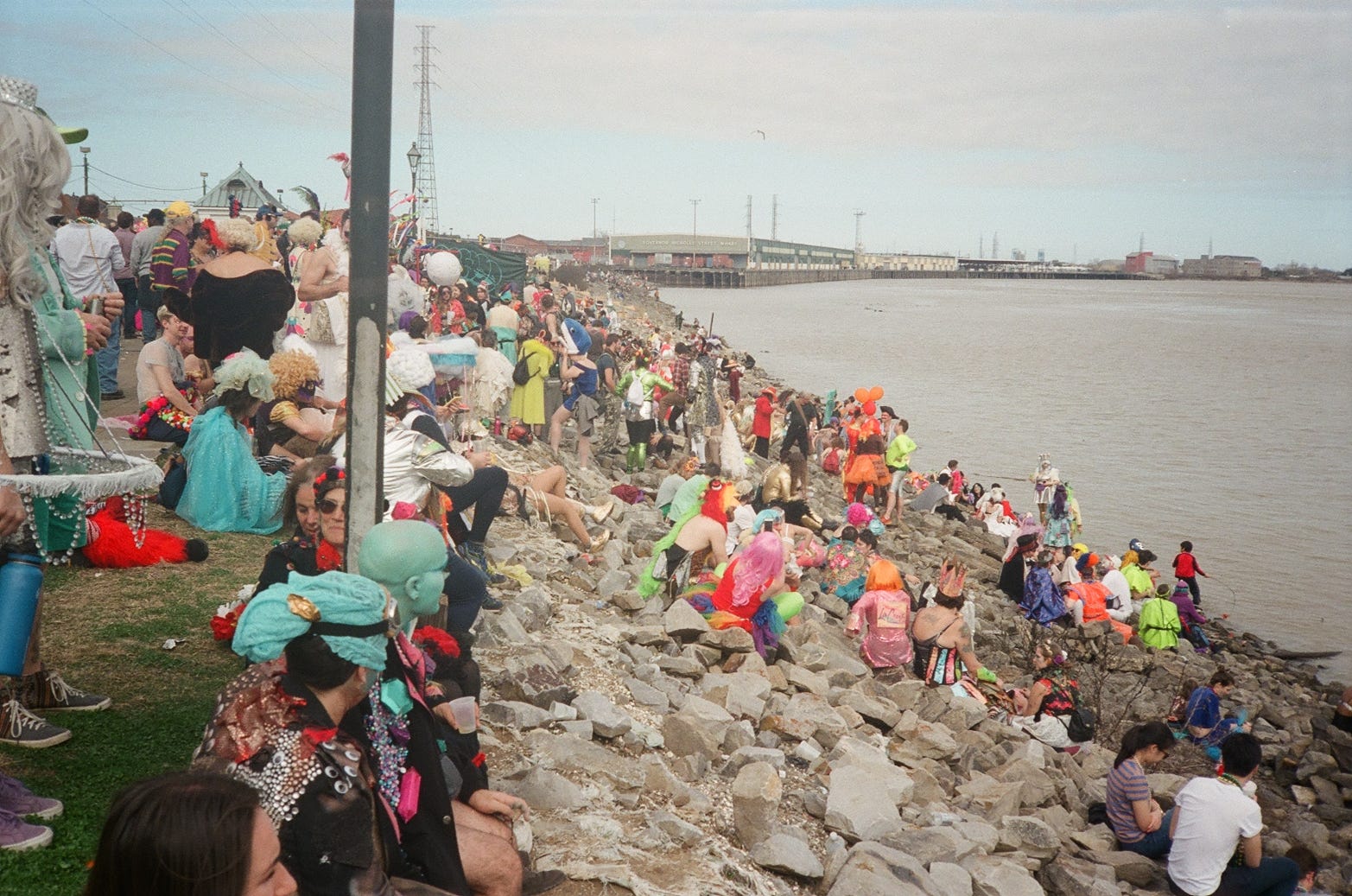
Many people ritualize death and honor the dead on Mardi Gras Day. Costumed walking parades process from the Bywater to the French Quarter, and end along the banks of the Mississippi where joyous brass bands shift their tone and accompany mourners with dirges to honor people they have lost4. Sitting amongst bright costumed bodies as they bring grief to the water’s edge feels powerful, peaceful, moving, and otherworldly. A death ritual that is completely public and intensely private. Seen and unseen.
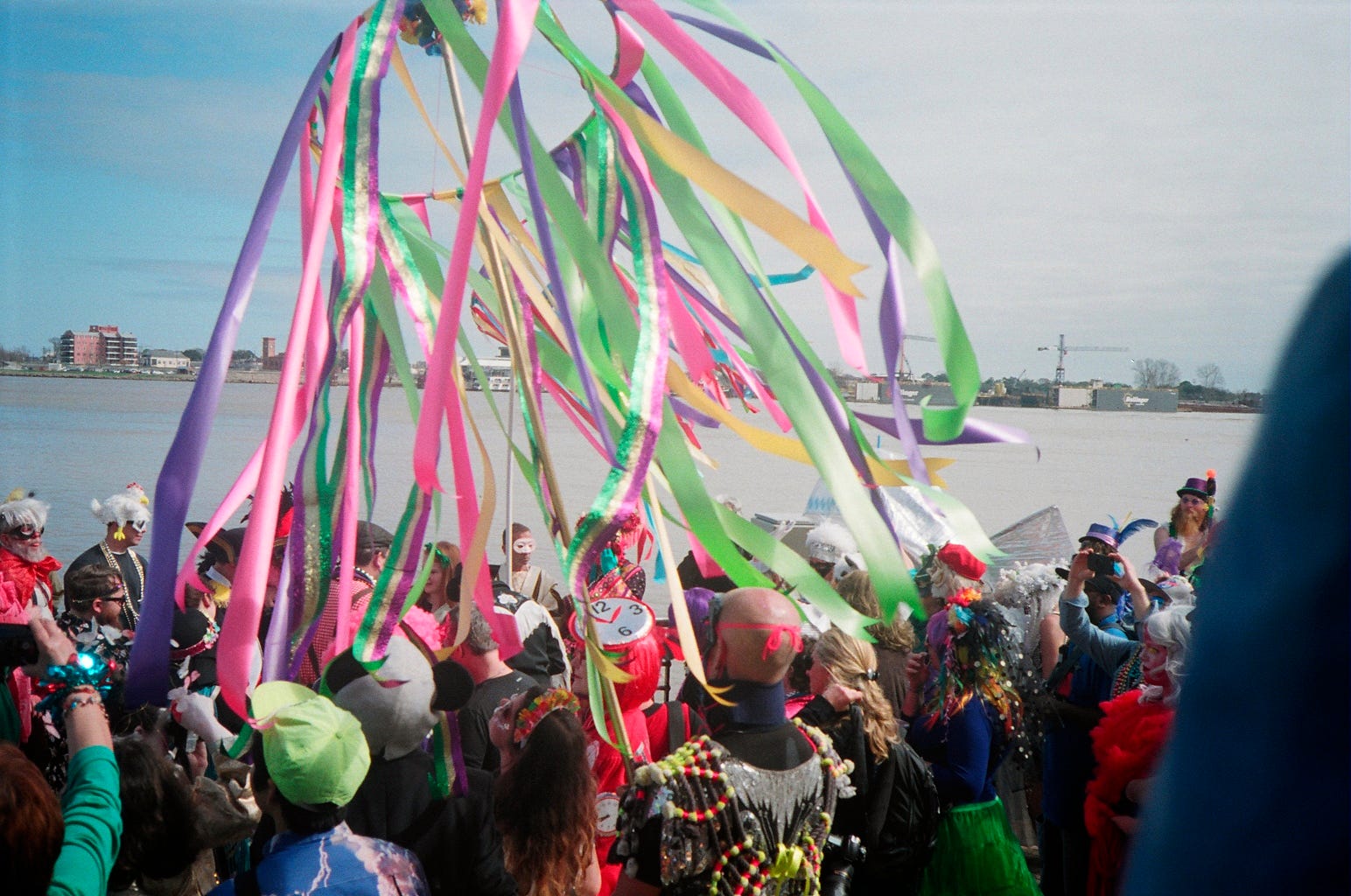
Leading up to the cathartic release of Mardi Gras Day, New Orleans throws parades and parties for weeks in formats big and small, bright and dark, hidden and offered up in plain sight.
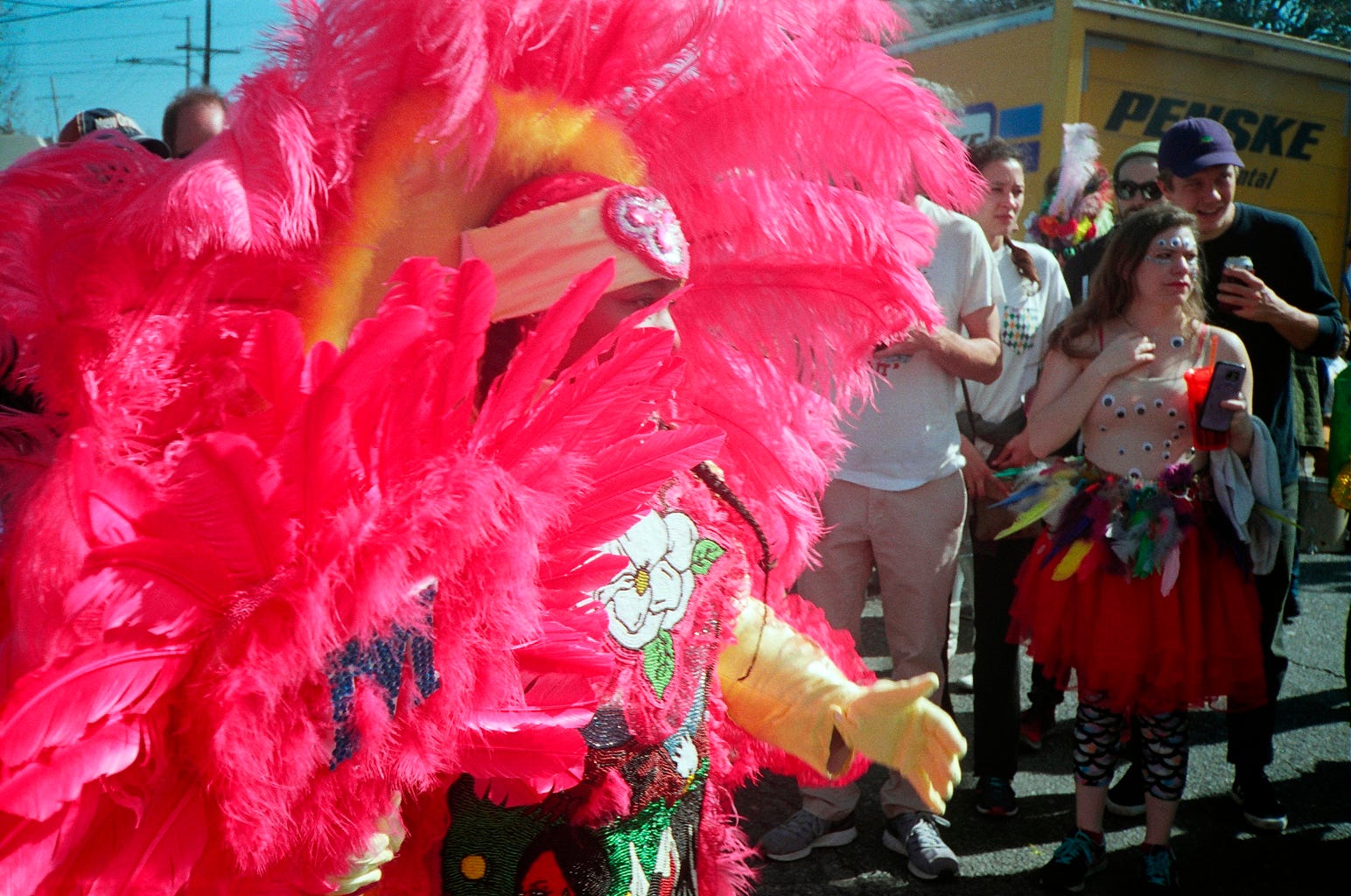
Mardi Gras Indians invest an entire year to create intricately beaded costumes. They lovingly sustain traditions with families and neighbors immersed in the songs, skills, roles, and social structures that only reveal themselves to the public at select times of year5. The complexity, depth, and beauty of this tradition may be one of the greatest cultural treasures in the world, and certainly this country. Its mysteries and secrets shield and protect what is sacred. The craftsmanship is breathtaking if you get to see Mardi Gras Indians up close6.
Disguise and Disorientation
In 2026, we relied again on the kindness, guidance, and housing of New Orleans friends who shared their costume bins and company. We dressed as monsters, surrealist dreams, imperial forces, bayou wolves, absinthe fairies, fringed cowboys, and warm girls. We reached our arms longingly towards Uptown floats and brought home useful and useless throws. We applauded the retro-inspired glass beads of conscientious Krewes. We coordinated successfully and unsuccessfully to link up with friends. We found friendly faces in the crowd just as often by chance as by text. We relaxed into the chaos of finding and following un-permitted walking parades. We relied on answering machines and fliers for choice information. We gathered in backyards, bayous, boulevards, and bars. Transforming our faces and bodies and spirits little by little each day.
We embraced the transformations of disguise and disorientation.
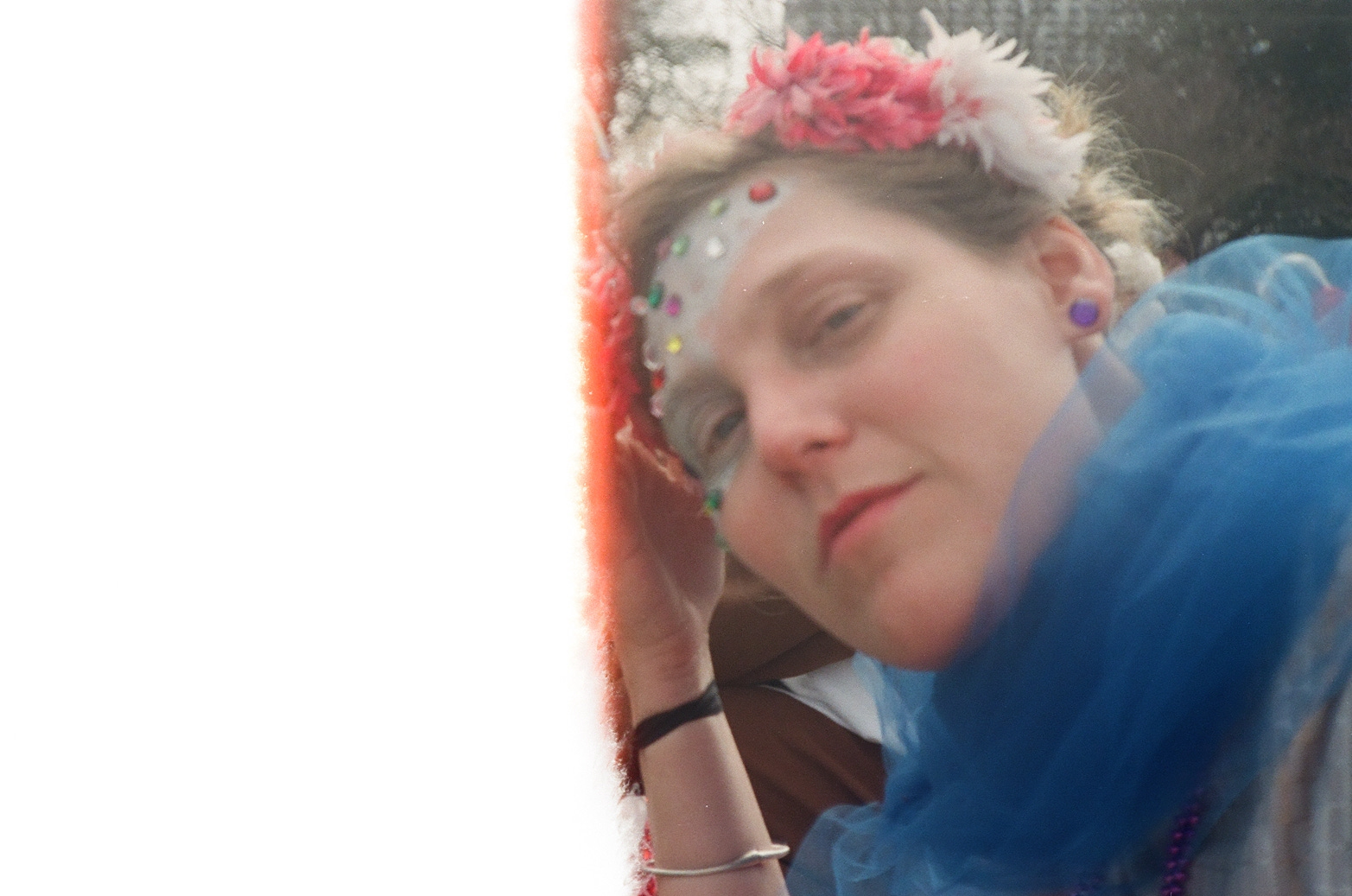
There is something about the Mardi Gras season and ritual that allows you to get entirely lost and found over and over again. There is no other experience I’ve had that allows for so much collective transformation at once. So much orienting and re-orienting to who you are, where you are going, and what this whole project of living is about. It reminds us of our mortality. It begs us to shed our skin. To shake our bodies. To reach out to strangers for generosity. To lean on friends for wild and brilliant acts of absurdity, expression, and taking up space.
An entire city walks the streets making big noises, wearing bright colors, and adorning themselves in anything that glitters or glows. Many segments of society carry their own subcultures and traditions—ancient and new. People come together to take up space and insist upon their humanity in the grand scheme of everything. In spite of all that goes on. Because of all that goes on.
Mardi Gras reminds us that we are human, mortal, here, moving. That we do not need to lay down in the face of unseen forces. That we can raise ourselves up, dress ourselves up, walk outside, and momentarily leave the hull of daily life behind. We shed our flesh. We claim our right to become something brand new. Alongside our people. Immersed in a sea of grieving, living souls.
And we can bring it all to the river at the end of the day.
In the song “Go To the Mardi Gras”, Professor Longhair implores listeners to go see the Mardi Gras and get a ticket in their hand. The ticket gets you to New Orleans. The rest is up to you to figure out. “Somebody’ll tell you what’s Carnival for”.
Words of gratitude and humility belong early and often in this piece. I owe my participation in Mardi Gras to the New Orleans friends who host us, guide us, and invite us into their traditions. For us, they are the lineage holders who generously allow me and Andy to share in the creativity and catharsis of Carnival season. Thank you to Catherine, Frank, Jakob, Jen, Kristy, Steve, Hannah and Sam for being culture bearers, true believers, and keeping the spirit alive. <3
Muses began in 2001 as the first all-female Mardi Gras Krewe. They parade on Thursday night and famously throw glittering shoes. Zulu Social Aid & Pleasure Club originates in 1916 and rolls on Mardi Gras Day. They are rooted in African American masking and processional traditions of New Orleans. Zulu revelers covet hand-decorated coconuts.
The Mississippi River looms large in the identity of New Orleans. Sediment from the river formed the city’s land. Commerce along its waterways drew people and economies from far and wide. Many parades during Mardi Gras move towards the river and the French Quarter. Perhaps an overt or instinctual tribute to ancestors of the city.
Documentary film “Bury the Hatchet” (Aaron Walker, 2010) paints a beautiful portrait of Mardi Gras Indians and shares their incredible history and evolution. The story and visuals are far too vast to delve into here. Local libraries offer streaming access via Kanopy.
To support ongoing efforts to preserve and perpetuate African American masking and processional traditions of New Orleans, consider backing the Backstreet Cultural Museum dedicated to this work since 1999. For helpful tips on photography etiquette around street parades, have a look at these “rules” shared by the Historic New Orleans Collection, compiled for a 2021 exhibition on Second Lines.